
JAPANESE TRAINS
Your complete guide to train travel in Japan — Shinkansen bullet trains, Japan Rail Pass, routes and tickets.

Japanese High-Speed TrainsJapan's Shinkansen — the world-famous bullet train — is the backbone of rail travel in Japan and one of the most advanced railway systems ever built. The Tokaido Shinkansen launched in 1964 as the world's first high-speed railway line, connecting Tokyo and Osaka and setting the global standard for rail travel. Today, the network spans over 3,000 km of dedicated track, operated by Japan Railways Group (JR Group) alongside dozens of private railway companies. Tokyo to Kyoto takes just 2 hours 15 minutes; Tokyo to Osaka, 2 hours 30 minutes. With zero passenger fatalities in over 60 years of operation, travelling by train in Japan is as safe as it is fast. |
Take a Look Inside Nozomi
The Nozomi is Japan's fastest and most popular high-speed service, running at up to 300 km/h on the Tokaido, Sanyo and Kyushu lines. Japan Railways Group — privatised from the Japanese National Railways (JNR) in 1987 — operates six regional railway companies including JR Central, JR East and JR Kyushu, plus hundreds of private railway companies nationwide. The Tokaido line alone carries over 5.6 billion passengers since opening, running up to 13 trains per hour during rush hour. France's TGV and Germany's ICE were both inspired by Japan's high-speed trains — yet the service remains the world benchmark for punctuality and reliability.

And What Is Mini-Shinkansen?Mini-Shinkansen lines extend Japan's high-speed railway network by converting existing narrow-gauge railway lines to standard gauge, allowing Shinkansen trains to run directly from the main network onto regional routes. The Yamagata Shinkansen (1992) and Akita Shinkansen (1997) are Japan's two Mini-Shinkansen routes — passengers board in Tokyo and travel without changing trains, even though the two sections use different track gauges. On converted sections, trains travel at up to 130 km/h rather than the full 320 km/h of mainline Shinkansen, but they dramatically shorten travel time compared to conventional services. It's a uniquely Japanese solution: maximum connectivity with minimum disruption. |

Types of Trains in Japan: Shinkansen ServicesJapan's high-speed network is served by six train types, each with different speeds and stopping patterns across the railway lines. Understanding the difference helps you choose the right service — and whether a rail pass or individual tickets make more sense for your trip.
|

Japan Railways Group and Private Railway CompaniesJapan's extensive railway network carries over 9 billion passengers per year — more than any other country. While the Shinkansen bullet trains (known as bullet trains worldwide) handle long distances between major Japanese cities, the full rail system in Japan includes long-distance trains, limited express trains, local trains and suburban railway lines. Japan Railways Group — made up of six regional rail companies including East Japan Railway (JR East) and a nationwide freight railway company — operates the backbone of rail services across Japan. Dozens of private railway companies in Japan run the rest, with many operating just a single line or a local network around major cities. Central Japan Railway Company (JR Central) operates the Tokaido Shinkansen and serves the Nagoya and Shizuoka prefectures, while JR Shikoku covers the four prefectures of Shikoku island. Major private railway companies such as Kintetsu and Tokyu each operate just a single regional network, running train services for short distances within their prefecture |

| Examples of limited express trains include the Narita Express (Tokyo's Shinjuku and central Tokyo to Narita Airport), the Haruka (Kansai Airport to Kyoto) and the Thunderbird (Osaka to Kanazawa). These train services require a surcharge above the basic fare. For everyday travel around Japan — local trains, subways, commuter trains — an IC card such as Suica or ICOCA covers all rail companies and makes every train ride effortless across Japan's rail network. Regional rail passes are also available for travellers focusing on one area, offering unlimited travel on JR train lines in Japan at lower cost than the nationwide Japan Rail Pass. Japan's train system also offers unique sightseeing trains and luxury trains — from JR Kyushu's Seven Stars to scenic super express services through the Japanese Alps. Whether it's a long-distance train ride between cities or a short hop on a local Japanese train, Japan's railway network has a train ticket for every journey. |
Book Train Tickets in Japan

Shinkansen Train RoutesJapan's Shinkansen network covers seven high-speed rail lines connecting all four main islands — from Hokkaido in the north to Kagoshima in the south. The Tokaido line (Tokyo–Osaka via Nagoya and Kyoto) is the world's busiest high-speed railway and the starting point for most trips to Japan. Heading north, the Tohoku and Hokkaido lines reach Sendai, Aomori and Hokkaido; the Hokuriku line serves the scenic Japan Sea coast via Nagano and Kanazawa. Most popular routes: Tokyo to Kyoto from ¥13,910 (2h 15min), Tokyo to Osaka from ¥14,450 (2h 30min), Tokyo to Hiroshima from ¥18,830 (3h 50min). Read More About Shinkansen Train Routes |

Japanese Train StationsHigh-speed train stations are served by dedicated platforms entirely separate from local trains — with signs in English, Japanese, Korean and Chinese throughout. Major hubs like Tokyo Station, Kyoto Station and Shin-Osaka Station offer extensive shopping, restaurants, coin lockers and direct connections to city metro lines. Ticket machines at all JR stations have English interfaces; staffed JR ticket offices (green 'Midori no Madoguchi' sign) handle rail pass activation and seat reservations. Key tip: Narita Airport connects to central Tokyo via the Narita Express (N'EX) in 50–90 minutes — covered by the pass. Read More About Shinkansen Train Stations |

Shinkansen TicketsEvery journey requires a basic fare ticket plus an express surcharge — usually issued as one combined ticket when you book online. Choose from reserved seats (recommended for popular routes and peak seasons), non-reserved seats, or premium Green Car and Gran Class upgrades. For travellers covering long distances, rail passes offer real savings: the 7-day Japan Rail Pass (¥50,000) covers unlimited travel on most high-speed and JR trains. Book online via Rail Ninja before your trip — search routes, choose seats and collect tickets at any JR station using a QR code. Read More About Japanese Train Tickets |
What to Know About Shinkansen Trains
- Are Shinkansen trains the fastest in the world?In regular commercial service, Japan's Hayabusa reaches 320 km/h — among the fastest trains in the world. Japan is also developing the Linear Maglev Chuo Shinkansen (Tokyo–Nagoya), with test runs already exceeding 600 km/h and commercial service expected around 2030.
- Why are Shinkansen trains so fast?Shinkansen run on dedicated railway lines with no level crossings, gentle curves and air-sealed carriages to handle tunnel pressure at speed. The trains are lightweight, highly aerodynamic (the Nozomi's nose exceeds 15 metres), and controlled by a sophisticated computerised system — the result is a ride smooth enough to leave drinks untouched at 300 km/h.
- Where do bullet trains go in Japan?The Shinkansen network covers all of Japan: Tokaido (Tokyo–Osaka via Nagoya and Kyoto), Sanyo (Osaka–Fukuoka via Hiroshima), Kyushu (Fukuoka–Kagoshima), Tohoku (Tokyo–Aomori), Hokkaido (to Hokkaido island), Hokuriku (Tokyo–Kanazawa) and Joetsu (Tokyo–Niigata). Mini-Shinkansen routes also serve Akita and Yamagata.
- Is the Shinkansen railway scenic?Absolutely. The Tokaido line offers a famous Mount Fuji view (sit right side heading west, ~40 min from Tokyo). The Hokuriku line passes through the Japanese Alps and Japan Sea coast. Even on the busiest routes, rail travel in Japan means constantly changing views between city skylines and rural landscapes.
- Is it allowed to eat onboard?Yes — eating and drinking are fully permitted on all Shinkansen. Buying an ekiben (station lunchbox) before boarding is one of Japan's great travel traditions; every major station sells dozens of regional varieties. Note: eating is considered impolite on local and commuter trains.
- Is it allowed to drink beer onboard?Yes, alcohol is permitted on all high-speed rail services. Picking up a cold beer or sake at the station convenience store before boarding is a perfectly normal part of the Japanese train experience. Some services also have trolley service selling drinks on board.
- Is Wi-Fi available onboard?Free Wi-Fi is available on most JR high-speed services including the majority of Nozomi, Hikari and Hayabusa trains. Signal can drop in tunnels and mountain areas — for consistent connectivity, a pocket Wi-Fi device or Japan eSIM is recommended.
- Where to put luggage onboard Shinkansen?Standard bags fit in overhead racks above your seat. Suitcases with total dimensions over 160 cm (H+W+D) require a pre-booked oversized baggage space — free if reserved in advance, ¥1,000 fee otherwise. Pro tip: use Japan's takkyubin luggage delivery service (Yamato Transport) to send bags between hotels for ¥1,000–2,500 per piece.
- How early should I arrive at the station?15–20 minutes before departure is enough for most travellers. Shinkansen depart to the exact second. For large stations like Tokyo or Shin-Osaka, allow 25–30 minutes. Train stations in Japan are well-signposted in English — the Yamanote Line in Tokyo and connections from central Tokyo to Shinjuku station are clearly marked at every exit. The sleeper train Sunrise Express also departs from Shinjuku, for travellers taking overnight rail services.
- Is Wi-Fi available at the stations?Yes — all major Shinkansen stations offer free Wi-Fi through JR-EAST FREE Wi-Fi or local station networks. A simple one-time registration is required. For hassle-free connectivity from the moment you land, a Japan eSIM set up before departure is the easiest option.
- Do I need to book Shinkansen tickets in advance?For popular routes (Tokyo–Kyoto, Tokyo–Osaka) and peak seasons — Golden Week, Obon, New Year, cherry blossom season — advance booking is strongly recommended as trains sell out weeks ahead. Outside peak periods, seats are usually available close to departure. Book online via Rail Ninja up to 150 days in advance.
You can also check Rail Ninja Reviews to find more information. - Are Shinkansen tickets refundable?Yes, unused tickets can be refunded. Cancellations more than 2 days before departure incur a flat ~¥320 fee. Same-day cancellations cost approximately 30% of the ticket price. Tickets become non-refundable after the scheduled departure time.
- Is the Japan Rail Pass worth it?The 7-day pass covers unlimited travel on most high-speed and JR trains, and makes financial sense if you're making multiple long-distance journeys — for example Tokyo → Kyoto → Hiroshima → Fukuoka and back. For shorter trips focused on one city or region, individual tickets or regional rail passes are usually cheaper. The pass must be purchased before arriving in Japan.
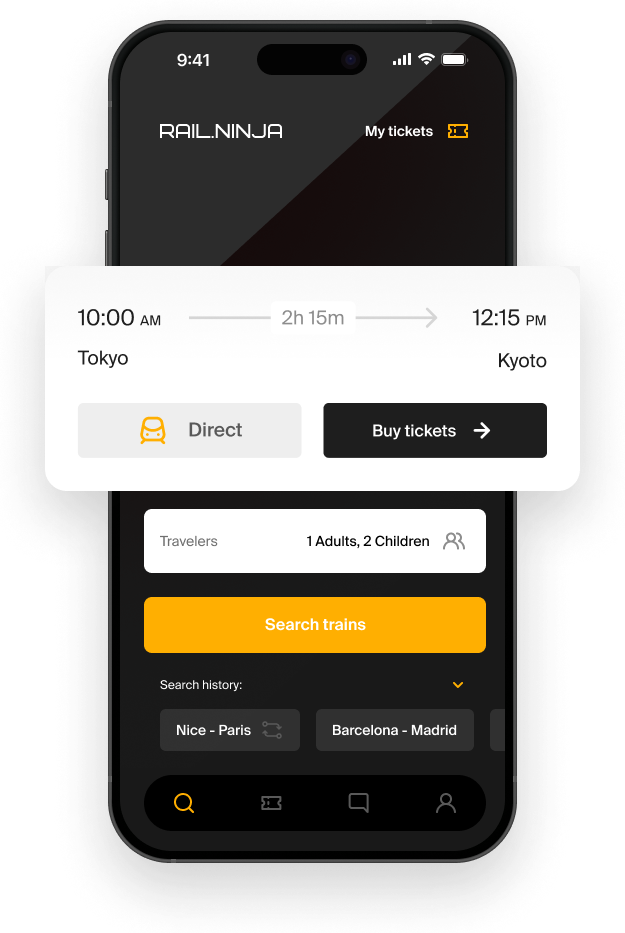
Try the new Rail Ninja App today
Get our free app to book & manage your trips on the go
Popular Train Routes in Japan
Travel the distance of 514 km in 2.5 hours!
Travel the distance of 816 km in 4 hours!
Travel the distance of 38 km in 15 minutes!
Travel the distance of 548 km in 2.5 hours!
Travel the distance of 340 km in 1.5 hours!
Travel the distance of 73 km in 0.5 hours!
